How to Read Forex Charts: A Visual Guide for Beginners
A forex chart is a visual record of what price has done. Every spike, every dip, every sideways grind — it's all there. Learning to read this information fluently is the single most important technical skill in trading. If you can't read a chart, you're flying blind.
This guide covers the three main chart types, how to interpret candlesticks, what timeframes mean in practice, and how to start extracting useful information from price action.
The Three Chart Types
Line Charts
A line chart connects closing prices over time with a single line. It's the simplest chart type and gives you a clean view of the overall trend direction.
When it's useful: Getting a quick sense of whether a pair is trending up, down, or sideways. Some traders overlay line charts on higher timeframes for a "big picture" read before zooming into detail.
Limitation: It ignores everything that happened within each period — the highs, lows, and opens. That's a lot of missing information.
Bar Charts (OHLC)
Each bar shows four data points: Open, High, Low, and Close. The vertical line represents the range (high to low). Small horizontal ticks on the left show the open and on the right show the close.
Bar charts pack more information than line charts but can feel cluttered, especially on lower timeframes. They were the standard before candlesticks gained popularity in Western trading.
Candlestick Charts
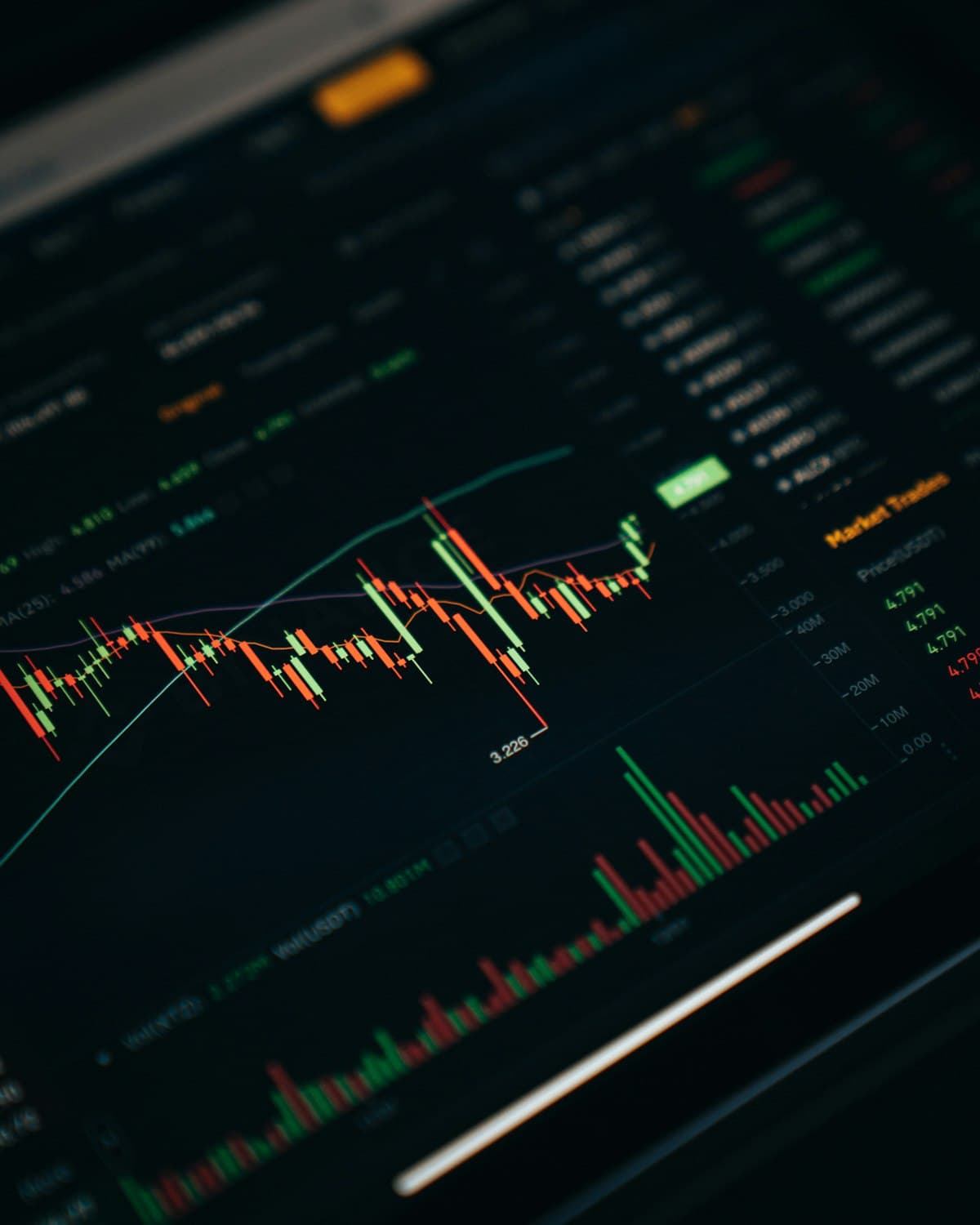
Candlesticks display the same OHLC data as bar charts but in a more visually intuitive format. The "body" shows the range between open and close, while the "wicks" (or shadows) show the high and low extremes.
- Green/white body: Close was higher than the open (bullish)
- Red/black body: Close was lower than the open (bearish)
Candlesticks are the industry standard for good reason — they make it immediately obvious who won each period (buyers or sellers) and by how much. Almost every retail and institutional trader uses them.

Reading Individual Candlesticks
A single candlestick tells a story about that period's trading activity:
Long body, short wicks: Strong conviction in one direction. Buyers (green) or sellers (red) were firmly in control.
Small body, long wicks: Indecision. The market explored both directions but ended up near where it started. These often appear at turning points.
Long upper wick, small body near the bottom: Buyers pushed price up, but sellers overwhelmed them and drove it back down. Bearish rejection.
Long lower wick, small body near the top: Sellers pushed price down, but buyers stepped in and drove it back up. Bullish rejection.
These aren't mystical signals — they're a visual summary of the battle between buying and selling pressure during that period. When you see specific candlestick formations, you're reading the footprint of actual market behaviour.
For a detailed breakdown of individual formations and multi-candle patterns, see our guide to candlestick patterns.
Timeframes: Choosing Your Lens
Every chart has a timeframe — each candlestick or bar represents a specific period. Common timeframes:
| Timeframe | Each Candle Represents | Typical Use |
|---|---|---|
| M1, M5 | 1 or 5 minutes | Scalping |
| M15, M30 | 15 or 30 minutes | Day trading |
| H1, H4 | 1 or 4 hours | Intraday/swing |
| D1 | 1 day | Swing trading |
| W1 | 1 week | Position trading |
| MN | 1 month | Long-term analysis |
The same pair looks completely different depending on the timeframe. EUR/USD might be in a clear downtrend on the daily chart while showing a short-term bounce on the 1-hour. Neither view is "wrong" — they're showing different slices of the same market.
A practical approach: Start with a higher timeframe (daily or 4-hour) to identify the overall trend direction. Then drop to a lower timeframe (1-hour or 15-minute) to find entry points that align with that trend. This top-down analysis keeps you trading with the larger flow rather than against it.
What to Look for on a Chart
Trend Direction
At any given moment, price is doing one of three things:
- Uptrend: Higher highs and higher lows. Buyers are in control.
- Downtrend: Lower highs and lower lows. Sellers are in control.
- Range: Price bounces between a ceiling and a floor. Neither side has control.
Identifying which state the market is in determines what kind of strategy you should apply. Trend-following strategies fail in ranges. Range strategies get destroyed in trends.
Support and Resistance
These are price levels where buying or selling pressure has historically concentrated. Support is a floor — a price level where buyers tend to step in. Resistance is a ceiling — where sellers tend to emerge.
They're not exact lines. Think of them as zones. Price often reacts around these areas rather than at a precise number. When support breaks, it frequently becomes resistance, and vice versa.
Our support and resistance guide goes deeper into how to identify and trade these levels.
Moving Averages
A moving average smooths out price data to show the average price over a set number of periods. The 50-period and 200-period moving averages are the most widely watched.
When price is above the moving average, the trend is generally up. Below, the trend is generally down. When a shorter MA crosses above a longer one, it's called a golden cross (bullish). The opposite is a death cross (bearish).
Moving averages lag — they react to price, they don't predict it. But they're useful for filtering noise and confirming trend direction.

Putting It Together: A Practical Chart Reading Process
Here's how experienced traders typically approach a chart:
Step 1: Zoom out. Start on the daily or weekly chart. What's the big picture? Is the pair trending, ranging, or at a major level?
Step 2: Identify key levels. Mark obvious support and resistance zones. Where has price reversed before? Where did it consolidate?
Step 3: Note the trend. Are we making higher highs or lower lows? Is the moving average sloping up or down?
Step 4: Zoom in. Drop to your trading timeframe. Look for candlestick patterns or price action signals near your key levels in the direction of the higher timeframe trend.
Step 5: Plan the trade. If you see a setup, define your entry, stop loss, and take profit before you click anything. Know your risk.
This top-down process keeps you disciplined. You're not guessing — you're building a case for each trade based on multiple layers of evidence.
Common Beginner Chart Reading Mistakes
Overloading with indicators. If your chart has seven indicators, four oscillators, and three custom overlays, you're not analysing — you're confusing yourself. Start with clean price action and add one or two tools as needed.
Ignoring the timeframe mismatch. A "buy signal" on the 5-minute chart means nothing if the daily chart is in a brutal downtrend. Always check the bigger picture first.
Drawing support and resistance from memory. Use actual chart history, not where you feel a level should be. Zoom out and look for where price has visibly reacted multiple times.
Trading every pattern you see. Not every doji, hammer, or engulfing candle is a trade. Context matters more than the pattern itself. A hammer at a major support level after a deep pullback is meaningful. A hammer in the middle of nowhere is just noise.
Confusing correlation with causation. Just because price bounced at a level three times before doesn't guarantee it will bounce again. Markets change. Participants change. Use levels as reference points, not certainties.
What Charts Can't Tell You
Charts show you what happened. They don't tell you why it happened, and they don't guarantee what happens next.
A central bank decision, an unexpected economic release, or a geopolitical shock can override any technical setup. Traders who rely purely on charts without awareness of the fundamental backdrop get blindsided by events they could have anticipated.
The strongest trades align technical and fundamental factors. That's something to build toward as you develop — but for now, getting comfortable reading price action is step one.
If you're just starting out with what forex trading is and how the market works, spend time watching charts without trading. Observe how price moves during different sessions, how it reacts at key levels, and what patterns tend to follow what conditions. Screen time is irreplaceable.
Want to practice reading charts in real time? Open a free demo account with ComoFX and watch live markets without risking any capital.